Sunday, February 22, 2015

The IRS Scandal, Day 654

The American Spectator, The Real ‘Dirty Dozen’ at the IRS: For Some Reason, It Fails to Include Itself on its List of Abusers, Scammers, and Cheats:
The IRS just released its “dirty dozen” list of tax scams and schemes for the American people to avoid. In addition to normal phishing and identity theft, a slew of new phone scams around the nation has caught many taxpayers off guard. Plus, unscrupulous return preparers take advantage of confused Americans, especially given that 60 percent of taxpayers need assistance figuring out all those documents, tables, and exemptions. The list also warns the less honest among us to avoid hiding money offshore, in abusive tax shelters, or with false documents. Additionally, it urges people not to falsify income or claim too much in fuel tax credits, either.
But there is an even more concerning “dirty dozen” list that the IRS wants the public to forget.
It’s been almost two years since the news broke that the IRS had been targeting Tea Party, pro-Israel, and other conservative groups — and a scandal erupted. Here are just a select few ways the IRS has mismanaged its problems and shown itself to be incompetent and untrustworthy:
1. Internal emails show these groups were targeted because IRS employees thought them “icky.”
2. Other emails showed that Lois Lerner was conspiring with the Department of Justice to prosecute conservative groups on trumped-up charges.
3. Lerner herself refused to testify to investigating committees and was held in contempt.
4. That didn’t stop her from defending herself to Politico magazine and complaining about being “harassed” for her role.
5. Then, the IRS claimed it had lost the most crucial batch of Lerner’s emails.
6. Oh yeah, and her Blackberry was destroyed too.
7. Six months later, the Tax Inspector General may have found those lost emails. (Still no word yet on what was in them.)
Scandal events aside, the IRS showed its general incompetence in many other ways.
8. IRS workers campaigned for political candidates while on the job.
9. The agency awarded bonuses to its own employees who owed taxes.
10. Guess who was audited ten times more often than the average taxpayer? Supporters of the Tea Party.
11. The IRS illegally shared confidential, protected information with the FBI, the White House, and more.
12. And it has the nerve to constantly ask for a raise.
It all adds up to an agency that doesn’t merit the trust of taxpayers.
For at least three years, the IRS has egregiously wronged this nation — including at least one person on a director level. Yet, it still hasn’t apologized or come clean.
But despite all the excuses and diversions offered by the IRS, the American people are still saying what Senator Ron Johnson expressed: “I smell a rat. I smell a number of rats, and that’s what we are going to get to the bottom of.”

Open source free download of new paper, which mentions growing opposition to FATCA and number of renunciations rising

Avi-Yonah, Reuven S. and Savir, Gil, Find It and Tax It: From TIEAs to IGAs (February 20, 2015). Available at SSRN: http://ssrn.com/abstract=2567646

and also Hatfield, Michael, Taxation and Surveillance: An Agenda (December 17, 2014). Yale Journal of Law & Technology, 2015, Forthcoming; University of Washington School of Law Research Paper No. 2014-34. Available at SSRN: http://ssrn.com/abstract=2539835 or http://dx.doi.org/10.2139/ssrn.2539835
“….This Essay provides an agenda of items for discussion, debate, and research related to the development, implementation, and effects of moving towards a surveillance-facilitated tax system.”

Monday, February 16, 2015

More on US hypocrisy

Article from the NYTimes investigating US real estate investments and “….United States laws that foster the movement of largely untraceable money through shell companies..”.
More US hypocrisy – as long as the US profits, they don’t give a damn about other countries. The goal is for the US to hold all the chips, and receive tribute and hold on to assets originating from the rest of the world.
US FATCA is a foreign aid program where all other countries of the world are forced via US extortion to send a portion of the fruit of their own citizens and resident labour to the US – in tribute, as a form of foreign aid to the US Treasury.

Comment on FBAR Willful Penalty

Kyle Niewoehner, Feigning Willfulness: How Williams and McBride Extend the Foreign Bank Accounts Disclosure Willfulness Requirement and Why They Should Not Be Followed, 68 Tax Lawyer 251 (2014), here.
and  DOJ and IRS Use “Carrot ‘n Stick” to Enforce Global Tax Laws, 29 Criminal Justice 4 (2014), here.

In Williams, the court held that failing to file an FBAR after signing a tax return constitutes “a conscious effort to avoid learning” about the FBAR requirement, which satisfies the willfulness requirement. In McBride, the court held that signing a tax return constitutes knowledge of the duty to comply with FBAR, which satisfies the willfulness requirement. By holding that taxpayers willfully violate the FBAR statute simply by signing a tax return and then failing to file, both Williams and McBride construe the willfulness requirement more broadly than applicable precedent would have dictated.

This Comment argues that the current text of the statute and precedent require a more narrow reading of the FBAR willfulness requirement. It argues that taxpayers should not be charged with constructive knowledge after signing a tax return. Instead, a court should have to find that the taxpayer is aware of the existence of the FBAR requirement in order to find a willful violation. In addition to being consistent with the text of the statute and precedent, this approach would avoid the liability nightmare created by a combination of the Williams–McBride strict liability standard and the ill-defined “other financial  account” language in the law.
Using the Williams–McBride standard of willfulness, it is difficult to conceive of how a violation could be nonwillful.
The Williams–McBride interpretation of the willfulness requirement in 31 U.S.C. § 5321(a)(5) is flawed because it imposes a strict liability standard where both the statute and the case law indicate otherwise.
The proper use of willful blindness is not to compel a finding of willfulness from facts from which a jury could infer the defendant willfully blinded himself, but to permit a finding of willfulness from such facts.  In other words, the jury must still find willfulness an intentional violation of a known legal duty -- but only as an inference which it makes applying the proper standard (preponderance, clear and convincing or beyond a reasonable doubt).  This test would then let the trier of fact determine willfulness.  The trier of fact's factual determination or willfulness or nonwillfulness could be reversed under the appropriate appellate standing -- clearly erroneous in a bench trial or no reasonable juror could find willfulness or nonwillfulness in a jury trial.  That is not the standard the Williams court applied and instead applied a legal conclusion that compelled the determination from the fact that the defendant did not read the 1040 and, for that reason, was willfully blind.
The solution for future courts is to look past the flawed Williams–McBride reasoning and adhere to the Sturman standard, which looked for an actual intent to violate the FBAR requirement or a course of conduct that would allow a court to infer willfulness. This would clearly avoid the liability problems created by the strict liability of Williams–McBride while upholding the relevant Supreme Court precedent and the current version of the statute.

Sunday, February 15, 2015

HSBC Links

Tax havens for despots, criminals and the Fortune 500 The Washington Post
Cites Nicholas Shaxson’s Treasure Islands: Tax Havens And The Men Who Stole The WorldSwiss Leaks frequently asked questions answered ICIJ Politicians, regulators face questions over HSBC cases ICIJ
HSBC could face prosecution, as Swiss Leaks fallout continues ICIJ
France says it did not restrict UK from using HSBC files to pursue bank and criminals The Guardian
As HSBC shows, we’ve been timid and pathetic in dealing with tax dodgers The Guardian
HSBC files: Swiss bank aggressively pushed way for clients to avoid new tax The Guardian
Bill Black: Criminal Tax Evader HSBC’s CEO Resorts to Bank Apologist Fable of the Virgin Crisis naked capitalism
BVI Premier: Most oppose public ownership registry The BVI Beacon
See also recent blog British government can (and should) impose public registries on its overseas territories
Mapped: The world’s biggest tax havens City A.M.
Draws on TJN’s Financial Secrecy Index

It appears someone is listening in the Administration at the Treasury; at least a little bit?

General Explanations of the Administration’s Fiscal Year 2016 Revenue Proposals (Released February 2015)    
Buried deep into the proposal of the US$3.99 trillion fiscal year 2016 expenditure plan, is a provision to “provide relief for certain accidental dual citizens.”  See pages 282 and 283 of the proposal.
The proposal has a window of opportunity that starts to close with time and then shuts in January 1, 2018;  i.e., the 2 year period after January 1, 2016.
Obama Budget Proposal to “Provide Relief for Accidental Americans”? Will the Proposal to Modify the Expatriation Rules Become Law?
The proposal would not adopt residency based taxation for all U.S. citizens, as it exists in the rest of the world, but would exclude certain U.S. citizens from the “mark to market” tax on expatriation (i.e., the “exit tax”) who :
  1. became at birth a citizen of the United States and a citizen of another country,
  2. at all times, up to and including the individual’s expatriation date, has been a citizen of a country other than the United States,
  3. has not been a resident of the United States (as defined in section 7701(b)) since attaining age 18½,
  4. has never held a U.S. passport or has held a U.S. passport for the sole purpose of departing from the United States in compliance with 22 CFR §53.1,
  5. relinquishes his or her U.S. citizenship within two years after the later of January 1, 2016, or the date on which the individual learns that he or she is a U.S. citizen, and
  6. certifies under penalty of perjury his or her compliance with all U.S.  Federal tax obligations that would have applied during the five years preceding the year of expatriation if the individual had been a nonresident alien during that period.
Only these U.S. citizen individuals (who meet all 6 criteria) will not be subject to any U.S. tax as a U.S. citizen but instead they will be taxed the same as a non-resident alien, which in effect is residency based income taxation for this narrow class of U.S. citizens.  The word tax is used generically, to presumably also exclude them from U.S. estate, gift and generation skipping transfer taxes.. 

Just a reminder of the phrase offshore FORMCRIME I created in 2012......

The IRS demands abject ‘compliance’ and obeisance to US extraterritorial taxation of citizenship, while increasing the burdens on and incomprehensible FORMCRIME enforcement campaign against those it insists are ‘US taxable persons’ ‘overseas/abroad’ around the entire globe, but laughably claims that “…. technological advances in communication have made the overseas field offices expendable.

40% accuracy related penalty Section 6662(a) and (j)‏ anyone ?

Income tax penalty related to foreign asset noncompliance where the base is the income, not the amount in the account. 
 Keep in mind, however, that that penalty applies only to years 2011 and forward. So earlier years are not subject to that penalty.
You may have to pay an accuracy-related penalty if you underpay your tax if, among others:
1. You showed negligence or disregard of the rules or regulations.
2. You substantially understated your income tax.
3. You claimed tax benefits for a transaction that lacks economic substance.
The penalty is 40 % of any portion of the underpayment that is attributable to an undisclosed noneconomic substance transaction or an undisclosed foreign financial asset transaction.- but it is were just deposits directly held in a foreign bank, obviously intended as an economic transaction, that penalty should not apply. Further the 20% and 40% accuracy penalty are not cumulative.

In 2010, Congress included within the accuracy related penalty provisions a penalty for “any undisclosed foreign financial asset understatement. I discussed above contemporaneous enactment of a requirement that individuals disclose their foreign financial assets on their tax returns, and this requirement somewhat overlaps the information requirement for the FBARs (which are not tax return forms and are not required by the Internal Revenue Code). There is now a separate Code penalty just for failure to provide the information, but if there is an understatement with respect to “any transaction involving an undisclosed foreign financial asset,” an accuracy related penalty of 40% applies. This penalty applies not only to the new required Form 8938 for return disclosure for foreign financial assets, but also to certain other information disclosures for foreign activities. The effective date for this provision is for taxable years beginning after the date of enactment (taxable year 2011 for most individuals).
The footnote for last paragraph is: "§ 512(b) of the HIRE Act (FATCA provisions)." Generally penalties are not made retroactive to years earlier than the legislation enacting the penalty. (By contrast, the 6-year statute of limitations for failure to report income related to foreign assets (Section 6501(e)(1)(A)(ii)) did have a retroactive date to cover all open years at the time of enactment. But, so the notion is, that is just a statute of limitations and not a penalty.

Tuesday, February 10, 2015

Step-By-Step Tax Filings For a Noncovered Expatriate

  • File your 2014 income tax return before the deadline. Depending on your situation, the deadline is either 15 April 2015 or 15 June 2015. I recommend that you file for an extension right now, and make an estimated payment that will more than cover any remaining income tax liability you think you might have to the IRS. The extension request will give you until 15 October 2015 to file your 2014 income tax return.
  • File your 2014 FinCen Form 114 by the 30 June 2015 deadline.
  • Your 2015 income tax return is a “dual status” tax return. It will consist of Form 1040NR, with information attached (usually in the form of a Form 1040) to explain your life from 01 Jan 2015 until 12 Feb 2015. It will also have Form 8854 attached to it. File it no later than the deadline for 2015 tax returns generally–either 15 April 2015 or 15 June 2015. Again, you can apply for an extension I would definitely do that as a pre-emptive strike prevent problems with deadlines.
  • You will also file 2015 Form 8854 by the filing deadline that applies to you for your 2015 tax return: 15 April 2016, 15 June 2015, or whatever the extended filing date is, if you request a filing extension.
  • File your 2015 FinCen Form 114 by the 30 June 2016 deadline.

Wednesday, February 4, 2015

ABA Tax Section Meeting Developments on Streamlined Disclosures

Andrew Velarde,  No Letters of Intent Allowed Before Entering Streamlined Program, 2015 TNT 22-7 (2/3/2015)

 1.  The IRS will not offer for the streamlined programs any analog to pre-clearance that is offered in the full-blown OVDP.  Taxpayers thus, theoretically, are at risk until they make the submissions required by the streamlined programs. The taxpayer receives no official acceptance if their request is approved, basically no news is good news with a 3 to 6 year potential audit period.
2.  The IRS has not yet developed statistics on the streamlined program (taxpayers joining and those rejected).
3.  The flagging of streamlined cases with at least 5 foreign information returns.  The IRS representative "said the initial examination referred to in the IRM is more for completeness and coherence.
4. There is no solution in sight to the long delays for some long-time foreign residents without Social Security Numbers (SSNs).  The problem is that those taxpayers, often prime candidates for the streamlined solution, cannot pursue the solution until they get SSNs, but have significant difficulty and time delays in getting SSNs. ( So long as the US taxpayer has begun the process of applying for a SSN, he can submit to the IRS the required Streamlined (or OVDP) paperwork along with a passport copy and a cover letter explaining that the SSN has been applied for. The IRS will issue a special IRS number for that taxpayer to use on all correspondence with the IRS. Once the SSN is obtained, the taxpayer must advise the IRS).
 5.  LoL....the IRS representative said that the IRS will not issue additional guidance on the meaning of willfulness in the streamlined program.

The problem continues to be that the IRS’ right hand does not know what the left hand is doing.

Monday, February 2, 2015

IRS TO ISSUE MORE TICKETS TO THE TAX COURT IN 2015

The IRS has signaled that it will be issuing more 90-Day Letters in certain cases where a taxpayer fails to satisfy a revenue agent’s request for additional facts in an examination.
Previously in an unagreed case, it was not that hard to remove a case from the agent’s (or examination’s) jurisdiction, and obtain a conference with an Appeals Officer before the case status changed to “docketed status”. To greatly simplify what the procedure was, assume a taxpayer cannot settle a case with the agent in an audit. The taxpayer simply writes a letter to the agent and says, “We’re getting nowhere. Please issue the 30-Day Letter (essentially the revenue agent’s report) so that I can file a protest and go to Appeals."
Normally upon receipt of a 30-Day Letter, the taxpayer then has a choice to write up a Protest Letter and request either a meeting with the agent and his manager or ask the agent to send the file to Appeals for a conference there. If the taxpayer elects to go to Appeals, in most cases, the examination managers are happy to do anything which will help them reduce their inventories and gladly oblige. The case then goes to a local Appeals Office where it sits there for a long time until an Appeals Officer is free to work the case.

Switzerland Remains Offshore Wealth Magnet

http://www.valuewalk.com/2015/02/switzerland-remains-offshore-wealth-magnet/

2015 the year of increased penalties

Generally, taxpayers who submit a request for participation in the OVDP pay a miscellaneous offshore penalty equal to 27.5 % of the highest aggregate value of OVDP assets during the period covered by the voluntary disclosure. The offshore penalty is in lieu of all other penalties that may otherwise apply to the undisclosed foreign accounts, assets and entities, including FBAR and offshore-related information return penalties and tax liabilities for years prior to the voluntary disclosure period. These penalties could otherwise far exceed the value in an undisclosed offshore account. Howwever, the offshore penalty rate is increased to 50% under certain circumstances. Under the newly released list, the 50% penalty would apply if, at the time of making the initial submission to request participation in the OVDP to the IRS, the taxpayer had an account at any of the following:
1.    UBS AG
2.    Credit Suisse AG, Credit Suisse Fides and Clariden Leu Ltd.
3.    Wegelin & Co.
4.    Liechtensteinische Landesbank AG
5.    Zurcher Kantonalbank
6.    swisspartners Investment Network AG, swisspartners Wealth Management AG, swisspartners Insurance Company SPC Ltd. and swisspartners Versicherung AG
7.    CIBC FirstCaribbean International Bank Limited, its predecessors, subsidiaries and affiliates
8.    Stanford International Bank, Ltd., Stanford Group Company and Stanford Trust Company, Ltd.
9.    The Hong Kong and Shanghai Banking Corporation Limited in India (HSBC India)
10.    The Bank of N.T. Butterfield & Son Limited (also known as Butterfield Bank and Bank of Butterfield), its predecessors, subsidiaries and affiliates
11.    Sovereign Management & Legal, Ltd., its predecessors, subsidiaries and affiliates (effective 12/19/14)
12.    Bank Leumi le-Israel B.M., The Bank Leumi le-Israel Trust Company Ltd, Bank Leumi (Luxembourg) S.A., Leumi Private Bank S.A. and Bank Leumi USA (effective 12/22/14)

Saturday, January 31, 2015

The IRS Scandal, Day 632

New American, Surveillance of the Right Is Not New: The IRS Scandal in Historical Perspective:
IRS Logo 2
The Obama administration’s ongoing coverup of the IRS scandal about targeting the Tea Party is not the first instance of the federal government persecuting the political Right with IRS audits. In fact, the current IRS scandal — where Lois Lerner’s Blackberry and her desktop computer have apparently been wiped clean to destroy evidence — are actually following a more than 50-year script for government to destroy the political Right in the form of the “Reuther Memorandum.” “The flow of big money to the radical right should be dammed to the extent possible,” the “Reuther Memorandum” informed the Kennedy administration, asking for political assistance in stemming that flow. ...
Several lessons can be learned from the 1960s. The first is that the perseverance of The John Birch Society in the wake of such government persecution and surveillance over the past 55 years should be a source of hope for modern Tea Party organizations. The Obama administration has tried to delay and deny tax-exempt status designations from the IRS in order to starve the Tea Party for funds because they know most corporations and foundations won’t donate to an organization without a 501(c)(3) or 501(c)(4) tax-exempt designation from the IRS. Despite the intimidation, IRS harassment, and media ridicule, the JBS remains a major fixture on the political Right today.
Secondly, the experience of The John Birch Society teaches the lesson that government can’t be trusted — even the administration of the allegedly sainted and martyred John F. Kennedy — and its secrets need to be revealed through dogged congressional investigations and strong public information laws. Public information laws needed include a strengthened Freedom of Information Act, as well as stronger whistleblower laws so that public informants such as Edward Snowden can come to Congress with information about blatant government violations of the U.S. Constitution without fear of prosecution. Most of what we know about the FBI and IRS persecution of political groups — both in the 1960s and under the Obama administration — came from the congressional investigations and whistleblowers who testified before them.

Luring the rich: investor residence and citizenship packages

CBC ran a story yesterday on Canada allowing rich people to buy permanent residency status, which provoked some discussion on twitter about whether such a thing was something associated with secrecy jurisdiction (aka tax haven) behavior. I don't know what kind of behavior this is, but I think it is widespread and growing. It's all part of the complicated dance politicians around the world are doing: all trying to lure rich people and multinationals from everywhere else, in a relentless quest to keep impossible electoral promises about jobs and growth.
All the programs listed here are for residency unless citizenship is indicated. One important recent development that is missing in the table involves Puerto Rico, which I suggested a long time ago was poised to be the last, best tax haven for US citizens (while the U.S. will remain the world's last, best tax haven for everyone else in the world, but that is a different story). Janet Novack ran a story on PR  Puerto Rico Expands Tax Haven Deal For Americans To Its Own Emigrants. It seems policymakers understand PR's unique position in the world vis à vis US citizens, but so far it is having a limited luring effect.

Thursday, January 29, 2015

Should or must I file a state income tax return if I live abroad?


If you are a US citizen or permanent resident living abroad, you not only have to make sure to file a tax return with the IRS each year if you meet the minimum income requirements, you may also have to file a state return.
Depending on the state where you lived immediately before your move, you may need to file a non-resident state income tax, even if you live abroad. Do not assume that since you left the United States, you are not required to file a state tax return. Each state has its own set of rules it considers a “resident” and their own minimum deposit requirements. Most states, but not all, also allow the exclusion of foreign income earned in determining taxable income.

Hiding Money or Income Offshore Among the “Dirty Dozen” List of Tax Scams for the 2015 Filing Season

The IRS released IR-2015-09 (1/28/15), here, which I quote in full:
Hiding Money or Income Offshore Among the “Dirty Dozen” List of Tax Scams for the 2015 Filing Season 
IR-2015-09, Jan. 28, 2015 

TAS - Executive Summary on Offshore Matters

The link to the full report in PDF format is
http://www.taxpayeradvocate.ir...
The sections dealing with OVDP are on pages 79-93, and legislative recommendations on pages 331-344. These numbers are the numbers at the bottom of each page.
I consider pages 79-93 to be excellent because they are thorough, well researched, and address key points. Some of the key stats (You should look at the tables) re: 8,851 streamline cases through 4/24/14, (apparently most of these are Canadians) and a total of 11,146 cases in the 2009 OVDP, 13,189 in the 2011 OVDP, and 6,930 cases in the 2012 OVDP (as of 9/30/2014.)

From a policy perspective, that's about 31,000 OVDP cases out of a universe of hundreds of thousands if not millions who should be filing FBARs. Clearly not a success, and I believe that the harshness of treatment for early participants, and fear of optouts has kept and will continue to keep many away.
Processing times of "only" 219 days for closed certifications and 308 days for closed optouts are far lower than the experience/reality shows .
The figures also show how low optout penalties were (granted, only those with the most favorable facts opted out.)
The TAS is proposing ceilings on FBAR penalties, both balance-based and based on previously unpaid tax. These are sorely needed.
Though the TAS only references a TNT (Tax Notes Today) article about the IRS OVDI FOIA documents, the training does assume that with few exceptions those who had not disclosed their foreign accounts were willful, and I am grateful to the TAS for combating this perception. The TNT article is at http://www.taxpayeradvocate.ir...

"What the OVDP Training Materials Tell US"

There is a brief article in Tax Notes Today based on the FOIA documents, "What the OVDP Training Materials Tell US" by Marie Sapirie, 2014 TNT 230-2 published 12/1/2014:

I was hoping to find memos or guidance as to how some of these decisions were made..... I don't think there's anything in there that comes as a big surprise forthose of us who have done hundreds of these [offshore voluntary disclosures].....Did this taxpayer act like anordinary, reasonable, prudent person?"..... lack of knowledge of the filing requirement is generally not reasonable cause.....one way taxpayers could establish reasonable cause was to show reliance on professional advice.......
"there are legitimate or non-tax motivated reasons [why] a U.S. Taxpayer would engage in offshore transactions.".......The IRS struggled with how to deal with offshore accounts and transactions that were not used for tax fraud, but that had not been reported........"Agents were encouraged to "put themselves in the taxpayer's shoes, understand the motivation for going offshore, and judge the reasonableness of their explanations for a specific transaction in that light.".......

https://www.bragertaxlaw.com/d...

Tuesday, January 27, 2015

Why Eric Holder's "Good Deed" on Civil Forfeiture...Wasn't That Good


One of the departing initiatives taken by retiring US Attorney General Eric Holder was to impose limits on a legal process called “adoption.”This is not the kind of adoption in which you add a child to your family. It is a process that allows local, county, or state police agencies to confiscate assets under federal civil forfeiture laws. In effect, the feds “adopt” the forfeiture and kick back up to 80% of the proceeds to the agency that originated the seizure.
The feds call this processing “equitable sharing.” A better term would be “legalized theft.” It’s almost beyond belief that the feds would actively encourage police departments to keep most of the money they seize, but they do. Not surprisingly, this inherently corrupt “policing for profit” scheme has led to abuse after abuse.
Civil forfeiture is a procedure that permits police to confiscate property without convicting, or even charging, the owner with any crime.
The cases have names like these:
  • United States vs. 867 County Road 227
  • United States vs. $124,700 in US Currency
  • United States vs. James Daniel Good Real Property.

It's Hard for Minors to Expatriate

U.S. citizen parent wants to renounce citizenship and is curious about a child's ability to do so.
My child is not 18 yet. Can he renounce his U.S. citizenship?

Quick Answer

In theory, a minor can renounce U.S. citizenship after age 16 and before age 18.
In practice? I have not seen it happen; I tell people to wait.

Parents Have No Power

First things first. A parent has no legal power to cause a child's citizenship to be renounced. As the State Department's Foreign Affairs Manual notes:
Expatriation, like marriage and voting, is a personal elective right that cannot be exercised by another. Parents or legal guardians cannot renounce or relinquish the nationality of their children or wards, including adults who have been declared mentally incompetent. 7 FAM 1290 provides guidance regarding loss of nationality and minors, incompetents, prisoners, plea bargains, and other special circumstances.1
It's your kid's decision and your kid's action to take. Let's take a look at the situation from point of view the Embassy official who is facing a child who seeks to renounce citizenship. It's all too easy for this person to say “No.”

Monday, January 26, 2015

‘FATCA: A Damaging Effort to Tax Foreign Accounts’

 FATCA is the tool to enforce U.S.
citizenship-based "place of birth taxation". Therefore, a separate goal is to bring an end to "place of birth" taxation. Think of how unfair it is to levy taxes on people based on their "place of birth" (and this is going on the 21st century).
FATCA will, in the end, draw much attention to the fact that the U.S. itself isn’t particularly compliant with the wishes of other countries searching for hidden assets. For instance, overseas companies such as Taiwan’s Acer or France’s Alcatel-Lucent have flocked to the U.S. and taken refuge in Wyoming or Texas (both of which boast across-the-board low tax rates and a zero-percent corporate income tax).  Perhaps, then, the U.S. should start rewarding those who keep their money within borders, instead of trying to beat-up those who didn’t.”
Presently the U.S. has no reciprocity on FATCA and is the only OECD member of the entire 34 not to have committed or signed up to the CRS.
This means that the U.S. is the biggest secrecy jurisdiction in the world and remains so, whilst weakening all the others.This means the hot money will go to the US. Given that there is no way they’ll get even close to the $8.9B they say they estimated, the only “benefit” of FATCA is that money flows to the US.
Also, nothing has changed. For financial secrecy, in general put you money in the US. For secrecy of beneficial ownership go to the Caymen Islands. For corporate secrecy keep ownership at less than 25% in an Inter Governmental Agreement country. It’s shocking, world wide misery on a worldwide scale with nothing positive achieved.

Offshore Voluntary Disclosure Program's Non-Willful Narratives

The IRS's 2015 versions of the two streamlined procedures OVDP forms (Form 14653 and Form 14654) require taxpayers to "provide a “narrative statement of facts” explaining their failure to disclose their offshore assets, or the agency will consider the applications incomplete and the taxpayer won't get penalty relief."
The forms—Form 14653 (used by non-residents) and Form 14654 (used by US residents)—are for taxpayers to certify that their conduct was not willful, a prerequisite to qualifying for little to no penalties.

Thursday, January 22, 2015

surprise, surprise......

Prosecutors Return $447,000 in IRS Civil Asset Forfeiture Case

Federal prosecutors have agreed to return nearly $447,000 to a small business whose assets had been seized by the Internal Revenue Service and Treasury Department agents as part of the controversial civil forfeiture program.
In 2012, the IRS seized $446,651.11 from a Long Island convenience store distributor, Bi-County Distributors, and its owners, the Hirsch family, based on a pattern of cash deposits that had been deemed suspicious by federal agents. Federal law requires banks to report cash deposits larger than $10,000 to the IRS. Since the Hirsches frequently made deposits in amounts less than $10,000, the government claimed they were seeking to evade the reporting requirement.

Wednesday, January 21, 2015

How The IRS Turned Carole Hinders’ Life Upside Down

Iowa restaurant owner’s fight against the IRS gains national attention.
A restaurant owner in northwest Iowa has landed in the national news spotlight over her fight with the federal government. Carole Hinders who at the time was 67 years old and a grandmother has operated Mrs. Lady’s Mexican Food in Arnolds Park, Iowa for 38 years.
Nowadays it is most notable for a small business to be in operation for 38 years – especially if it is a restaurant which we all know “come and go”. Even more notable for Ms. Hinders was that she was always in full compliance with her tax obligations. But despite her clean tax record, on May 22, 2013 while settling into a crossword puzzle with her grandchildren she was visited at her home by a pair of IRS agents who stated that they had closed her business bank account and seized all her money, which at the time was almost $33,000.
As the IRS agents were leaving her house she pleaded “How am I supposed to pay my bills? How am I supposed to pay my people?” The agents replied – we don’t know.
You may ask how could this have happened? She did not have any outstanding liability to the IRS. The problem though is that Ms. Hinders’ restaurant only accepts cash so Ms. Hinders makes frequent trips to the bank to avoid having large sums of money on the business’ premises.
As part of the federal government’s dragnet surveillance of the civilian population, everyone’s banking activities are monitored for “red flag” activities. Under the Bank Secrecy Act of 1970, banks are required to report to the IRS transactions on every individual who deposits or withdraws more than $10,000 in cash to or from a personal bank account on a given day. These reports indicate the financial activities that took place and include the individual’s bank account number, name, address and social security number.
People who know of this law and are seeking to avoid this level of reporting by the bank will often go to great lengths to make multiple deposits so that no single deposit will be greater than $10,000. This tactic is called “structuring”. The IRS thinking that Ms. Hinders was making small deposits to evade this reporting requirement used its civil forfeiture power to seize Ms. Hinders’ bank account and close down her business.
That’s right – federal law enforcement agencies are invested with the power of civil forfeiture whereby the federal agency can take cash, cars and other property without charging the property owner with a crime. The property owner need not receive any advance warning or notice before the assets are seized by the federal government. The government need not prove that a person is guilty of a crime – only that he or she is suspected of committing a crime. This law was designed to catch terrorists, money launderers, drug lords and serious criminals – but it can also be used by the government against law-abiding businesses.
Ms. Hinders said she received no warning from either her bank or the government before her money was taken. The reason that the federal government does not have to read you your rights, or advise you that you can have a lawyer, or do any of the things that the constitution is supposed to provide, is that they don’t charge the person with the crime – instead they charge your money with the crime.
Since then, she’s had to borrow money and use credit cards to pay bills and keep her restaurant in business. But Ms. Hinder was not stopping there – she knew she didn’t do anything wrong and did not owe anything to the IRS. But yet the IRS took her money so Ms. Hinders’ decided she was going to fight the IRS.

Logic of Firing IRS Chief Comes Into Sharp Focus As Agency Bridles at Budget

The Internal Revenue Service now says that taxpayers had better get used to shabby service from the tax collection agency. The IRS is hardly an agency known for warm and friendly service to begin with. Complaining about belt tightening budget cuts, this week IRS Commissioner John Koskinen lectured: “People who file paper tax returns could wait an extra week — or possibly longer —to see their refund. Taxpayers with errors or questions on their returns that require additional manual review will also face delays.” ...
Congress needs to hold the IRS accountable and demand the firing of Mr. Kostiken because he has he admitted openly he can’t do his job. The IRS is nearly an $11 billion a year agency with some 100,000 employees. Congress wants to cut its budget by less than 4% and the agency says it can’t function. During the recession many businesses took cuts of 30% or 40%, and they did it by becoming more efficient and cutting waste. Meanwhile the IRS has spent millions of dollars on conferences at exotic resorts for its employees with some suites costing $3,000 a night. And Mr. Koskinen says he can’t find places to cut.
The IRS has also been rocked by scandals of targeting, abusing and financially harming individuals and conservative groups it doesn’t agree with. Maybe it could shut down that division and use those resources to help taxpayers. Instead of showing remorse the agency brass is petulant. The attempt to extort more tax dollars out of taxpayers is the so-called Washington Monument ploy, and Congress should demand an immediate private audit of the agency’s spending habits.
Washington demands full accountability and accuracy from tax filers, but the tax collection department is the least accountable agency of government. If the IRS can’t administer the tax code with 100,000 employees, it sounds like we need a new IRS and a new tax system.

Opinion on CBT vs. RBT or the “patriotism auction” re-election game aka. offshore treasure story

What is the argument for a residential or territorial tax system, as opposed to a citizenship-based tax system?

Please accept in advance my apologies for any feathers I might ruffle with my politically agnostic real world observations below. While some may call my observations cynical, I am attempting to answer this as an observer of the world as it is; not how it was; or how we wish it to be. In other words, I will try to be the little boy who pointed out that the Emperor has no clothes.
Given that the only real citizenship-based taxation (“CBT) regime is the US (apologies to those few remaining expat Eritreans who may pay a few % to their country for a clearance certificate), I will interpret the question to be whether there is any realistic chance that the US will abandon its current CBT basis for a residence based tax (“RBT”) regime .
There are several perspectives here to consider.
Group 1) US politicians;
Group 2) Americans who are not Golden Geese (1%ers) and will live in the US;
Group 3) Non-Golden Geese “Accidental Americans” who do not (and may never have) lived in the US, but who live, work, and will die in another taxing jurisdiction;
Group 4) Current or former US Golden Geese who may already be abroad or who could easily do so.

Tuesday, January 20, 2015

‘2015 Could Be The Year We Witness The ‘Weaponization Of Finance’

“Forget nukes and battleships. Washington may increasingly flex its geopolitical muscle in 2015 using an unconventional weapon: finance.
“Access to the US marketplace and US banks, and Washington’s ability and willingness to use them, are becoming more important as instruments of foreign and security policy,” Eurasia Group’s Ian Bremmer writes.
“There is no better example of this trend than the weaponization of finance — the systematic use of carrots (access to capital markets) and sticks (varied types of sanctions) as tools of coercive diplomacy,” he says.”
Exactly what FATCA is.
And it is being turned on allies like Canada and the UK, just as it is being turned on Russia, etc.
The US Treasury wanted NO exceptions for FATCA and the IGAs. Too much work. Just point the FATCA gun and wave it around in everyone’s face.
The article goes on to describe the drawbacks of this approach for the US;
“…….Although the “weaponization of finance” is a way to exert force without direct military conflict, the US risks further complicating political relations. And the strategy may see only limited success.”

FX rates for 2014 FBAR/FINCEN114 and Form 8938

 Treasury Reporting Rates of Exchange as of December 31, 2014

or 

 http://www.irs.gov/Individuals/International-Taxpayers/Yearly-Average-Currency-Exchange-Rates

IRS Issues John Doe Summons To FedEx, DHL, UPS, HSBC In Massive Offshore Account Hunt

A federal judge approved the IRS issuing summonses requiring FedEx, DHL, UPS, and a bevy of other handlers to produce information about U.S. taxpayers who used Sovereign Management & Legal Ltd. for offshore accounts and assets. They include Western Union Financial Services Inc., the Federal Reserve Bank of New York, Clearing House Payments Company LLC, and HSBC USA.
The IRS uses John Doe summonses to obtain information when it searches for tax fraud by individuals whose identities are unknown. This is a sweeping order, allowing the IRS to get records from all of these companies. The target is any U.S. taxpayers who, from 2005 through 2013, used Sovereign’s services to control foreign accounts or entities. That is likely to be a long list.
The IRS may face budget cuts, but the hunt for offshore evaders continues, this time out of a DEA operation. A DEA investigation of online narcotics trafficking got the IRS on to Sovereign, a company allegedly helping U.S. clients evade taxes. A taxpayer in the IRS offshore program (OVDP) reported that Sovereign set up his Panamanian shell, so now Sovereign is in the hot seat.
 http://www.forbes.com/sites/robertwood/2014/12/20/irs-issues-john-doe-summons-to-fedex-dhl-ups-hsbc-in-massive-offshore-account-hunt/

International tax training materials

The Service did caution that such training does not constitute pronouncements of law, and cannot be relied upon…but it will show how your agent will be approaching your audit.
http://www.irs.gov/pub/int_practice_units/

Avoid U.S. Taxpayer Status After Expatriation

Substatial Presence Test : Max 183 days/year or 121 days/year for 3 consecutive years.
Is there a different rule for expatriates? It seems that under section 877, those who expatriated between 2004 and 2008 have a 30 day limit per year in the 10 years after expatriation.
The same rules that apply to every other nonresident apply to expatriates: if you spend too many days in the United States in a calendar year, you will be a resident of the United States and taxable on your worldwide income.
Quick numbers to remember if you want to avoid being a U.S. taxpayer after giving up your passport or green card:
  • Never spend 183 days or more in the United States in any one year; and
  • If you return to the United States year after year, and if you want to be safe, keep the number of days in the USA to 121 (or fewer) every year.

Thursday, January 15, 2015

IRS Closes International Tax Offices

From Bloomberg: IRS Will Shut Last Overseas Taxpayer-Assistance Center’
I personally never liked the idea of these overseas IRS offices to begin with. They have always seemed to me to be an infringement of host country sovereignty and I am happy to see them disappear. In fact I don't believe any other country in the world has overseas tax collectors like this although I will have to do more research. This will also be a blow to the FATCA compliance complex which has frequently used "fear" of IRS overseas offices to sell their services.
 http://www.newsmax.com/Newsfront/irs-budget-shrinks/2015/01/14/id/618441/
Just 4 million USD in savings compared to the billions they are claiming exists abroad in potential revenue. Makes no sense, does it? And yet the IRS is stretched so thin and is being asked to do so much. Congress threw FATCA and ACA at them and then cut their budget? That's just nuts. And now everyone gets to suffer because the IRS doesn't have the staff to properly help US citizens in the US and the Commissioner is warning that refund checks will be delayed this year. What a mess.
They report that IRS offices in Beijing have already been closed down and the Paris, London and Frankfurt offices will be closed soon.  These offices were located at the US Embassies in those cities.  All the staff will be sent back to the US and all international taxpayer assistance will now be done from the US.

Great timing.  As more and more US Persons abroad are being FATCAed, they are desperately in need of reasonably priced assistance and reliable information.  Now as they try to make sense of US tax rules and reporting requirements that they never heard of and don't understand, they have fewer resources to make good decisions and get compliant.
That just doesn't make any sense, folks.  Before there was a Compliance Gap and a Communication Gap.  Keeping those IRS offices open and giving the staff the autonomy and resources to craft information campaigns to reach US Persons abroad would have been a damn good idea.  This would have sent an important signal to America's population overseas - yes, you have to file but we are here to help.
If the Bloomberg article is indeed correct then I would very much like to know what the IRS' Plan B is.  Assuming that they won't simply give up providing taxpayer assistance to US Persons abroad, how might they deliver those services from the US?  Is there any possibility that Americans abroad organizations and even citizens abroad panels could participate in the design of service delivery solutions?

All good questions to ask the IRS Taxpayer Advocate Service and you can do so right here.
Could the closures prompt a spike in passport/citizenship renunciations?
In response, the US might extend the "waiting" period to some incredibly long time (ten years?), post a list of "traitorous citizens" who wish to turn in their passports, and raise the price of renunciation...to some unaffordable level.
It doesn't look pretty, however you cut it.


Wednesday, January 14, 2015

Taxpayer advocate mentions the raw deal earlier OVDP victims had

Nina Olson, US Taxpayer Advocate: 2014 Annual Report to Congress
The report identifies at least 20 of the most serious problems facing taxpayers and offers recommendations to fix them. Some of the issues, like tax reform and IRS’s need to expand its various taxpayer services, affect virtually every American taxpayer. Others, like the Alternative Minimum Tax, refund delays, and tax-related identity theft, impact large groups of taxpayers.

Offshore Voluntary Disclosure (OVD) Program Inequities. The report describes the evolution of the OVD program and the disproportionate penalties it says were often imposed, particularly with respect to unrepresented taxpayers. The IRS changed the streamlined program in 2014 in ways that allow many taxpayers to pay lower penalties. However, the new rules do not allow taxpayers who already had entered into closing agreements with the IRS at higher penalty rates to amend those agreements. Therefore, taxpayers who are the most deserving of leniency because they were the first to acknowledge they had failed to comply with foreign account reporting requirements ultimately are paying substantially greater penalties than taxpayers who waited until later to acknowledge their noncompliance. Among other things, the report recommends that the IRS revisit this decision.

The TAS section of OVDP is very reasonable. What they propose could ease the burden of a lot of people (new balance limits indexed to inflation). Changing the closed agreements isn’t going to happen given what we know from the OVDP doc dump. They wanted the money and drove people with uncertainty (that did exist) to accept the deal.

Robert Wood's latest at Forbes: National Taxpayer Advocate Slams IRS Offshore Programs & FBAR Penalties, Demands Change

Tuesday, January 13, 2015

Who can believe anything the IRS says?

Koskinen of the IRS says:
…”“The opening of the International Data Exchange Service is a milestone in the implementation of FATCA,” said IRS commissioner John Koskinen in a statement.”
He claims that:
“With it, comes the start of a secure system of automated, standardized information exchanges among government tax authorities. This will enhance our ability to detect hidden accounts and help ensure fairness in the tax system.”……….
Using IDES, a Web application, the sender encrypts the data and IDES encrypts the transmission pathway to protect data transfers. Encryption at both the file and transmission level is intended to safeguard sensitive tax information….”…
But, also recently;
…..”….Internal Revenue Service (IRS) Commissioner Koskinen has advised employees that the budget cuts will result in reduced services to taxpayers. In an email to employees sent earlier today, Commissioner Koskinen advised that “realistically we have no choice but to do less with less.”
Forbes author Kelly Phillips Erb says:
“What does that mean for taxpayers?
Identity theft could increase. Despite the need for increased taxpayer protections against identity theft, the implementation of additional measures will be delayed. That’s bad news for taxpayers since, despite the efforts of IRS and other agencies to stem the tide of identity theft, scammers have grown more bold. TIGTA reported that telephone scammers, posing as IRS representatives, managed to steal more than $5 million from taxpayers last year. And as quickly as the scams are picked up, they change. IRS-Criminal Investigation has responded to what has been termed an “epidemic” of identity theft by ramping up investigations – but with wholesale cuts to IRS, expect those investigations to dip, too….”…
The Taxpayer Advocate and the GAO and TIGTA have all identified IRS data security wanting... see:

So any government with an IGA is exposing their financial sector and all their accountholders to an agency who admits it cannot cope, and who has already been taken to task for the inability to secure taxpayer data.

Monday, January 12, 2015

So many errors..............

Not only does it look like China is well on board the FATCA Express, it has been reported in the New York Times that China is now applying worldwide tax on its citizens no matter where they live! 
http://www.nytimes.com/2015/01/08/business/international/china-starts-enforcing-tax-law-for-citizens-working-abroad.html?hp&action=click&pgtype=Homepage&module=second-column-region&region=top-news&WT.nav=top-news&_r=1

 
..........but China does not tax non-resident citizens on a worldwide basis. The New York Times article is incorrect. Among other errors, the article conflates the worldwide taxation of residents with worldwide taxation of non-residents, confuses the definition of income with the definition of residence, and misses the point that some people who are physically non-resident may be resident for tax purposes.

Sunday, January 11, 2015

The return of Mr. Hom - case No.14-16214

This is good news and I am happy that Joe took the case pro bono.......

In the United States Court of Appeals
for the Ninth Circuit
JOHN C. HOM
Appellant,
v.
UNITED STATES OF AMERICA
Appellee.

ON APPEAL FROM THE UNITED STATES DISTRICT COURT
FOR THE NORTHERN DISTRICT OF CALIFORNIA
CASE NO. 3:13-cv-03721-WHA
HON. WILLIAM ALSUP, PRESIDING
____________________________________________________

 Pro Bono Counsel for the Appellant..............Joseph A. DiRuzzo, III and Jeffrey J. Molinaro

What is the burden of proof for civil willful FBAR penalties ?

P4 of Govt Motion for Summary Judgment in Zwerner - Knowledge

The reason this issue is so important for U.S. citizens and lawful permanent residents (LPRs) residing outside the U.S., is that few have historically filed FBARs.  Few may have had little knowledge or understanding of what is an FBAR in years past. Can the government truly take the position that “. . . But to establish a taxpayer’s liability under 31 U.S.C. Section 5321 for willfully failing to file an FBAR, the United States need not prove that the taxpayer actually knew of the FBAR requirements he violated. . . “?
This is a truly low bar and a low level of proof the government has, IF this is the law, particularly when the amounts of the penalties can exceed the value of the individual’s accounts in their country of residency.  To date, no appeals court has ruled on the question.
The current state of the law, leaves taxpayers at a terrible disadvantage when the IRS assesses FBAR penalties which seem to have little correlation with their failure to file the form.

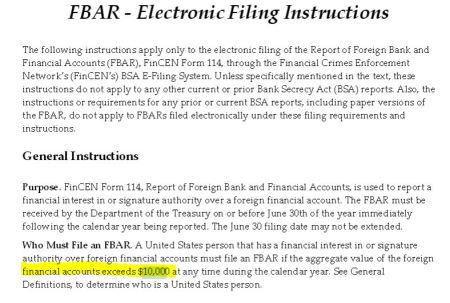
1970 Dollars: The Current Day US$10,000 FBAR Threshold Reporting


FBAR Electronic Filing Instructions


Front Page - of FBAR Electronic InstructionsThe relevant statute that requires reporting of a so-called foreign bank account report (“FBAR”) is Section 5314 of Title 31 .  This is not a federal tax law provision from Title 26 (aka I.R.C. aka Internal Revenue Code.)

There have not been extensive revisions to this Section 5314 over the years and it remains largely as originally drafted and passed in the year 1970.
See, Currency and Foreign Transaction Reporting Act of 1970, P.L. No. 91-508, 84 Stat. 114 (1970).
Curiously, the US$10,000 threshold amount is not reflected in the statutory language, nor in the regulations.  Instead, this US$10,000 threshold is set forth in the instructions of the form. See page 4 of the FBAR electronic filing instructions.

The point of this post is twofold:Inflation Adjusted Calculator of US$10,000
(1) the US$10,000 threshold amount is not part of the statutory or regulatory law; but rather is adopted in the instructions.
(2) US$10,000 in the year 1970 currently equals US$61,194 in inflation adjusted dollars (pursuant to the federal government’s CPI inflation calculator) which is a far different threshold for reporting

upside down - FBAR Lawyer moves to DOJ

Caroline D. Ciraolo of Rosenberg Martin and Greenberg LLP has moved to the US Department of Justice Tax Division in Washington, D.C